July 17, 2026
my morning cortisol reset routine — the 45 minutes that stopped my 3pm crashes
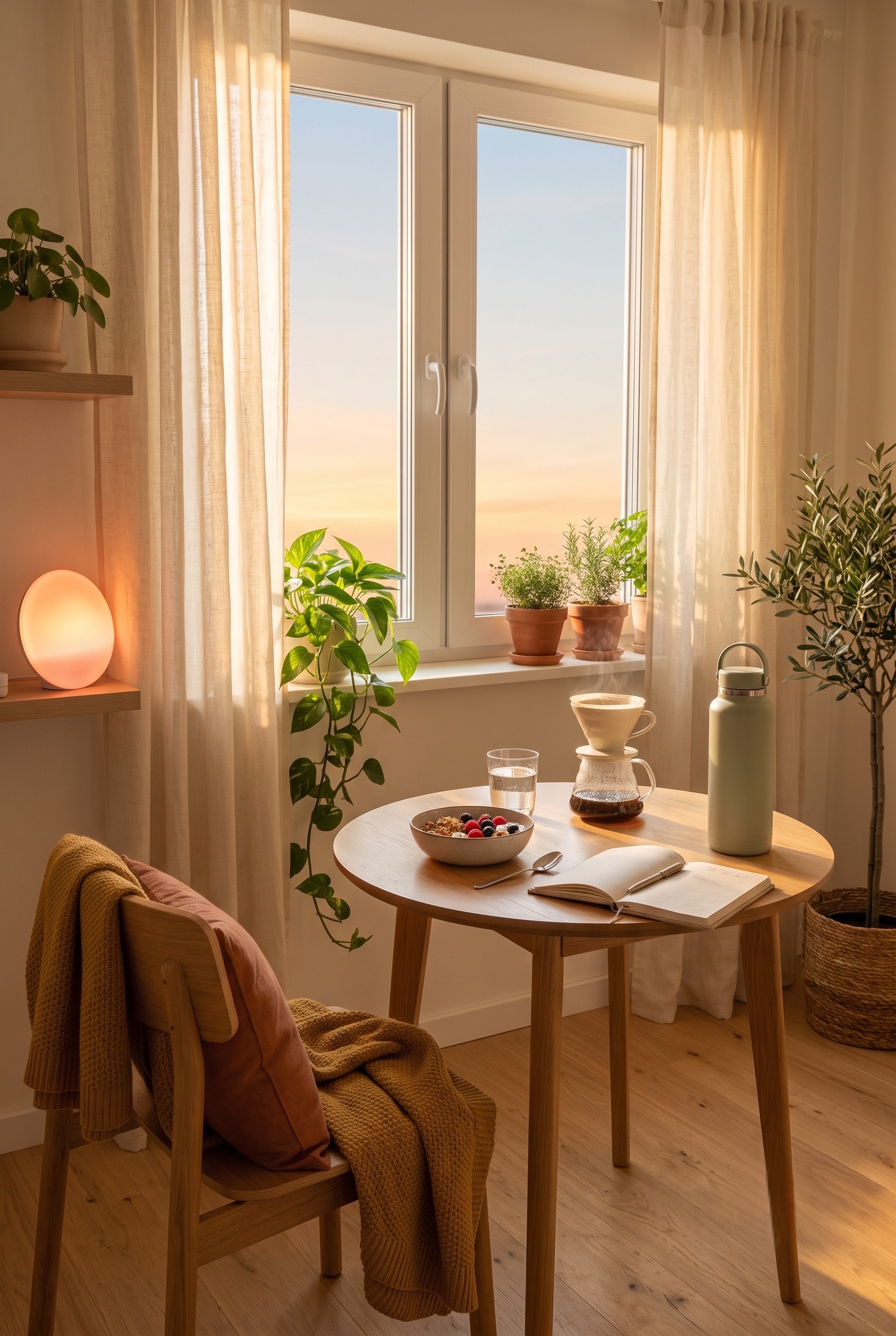
ok hear me out: your morning cortisol is not the enemy. Mine isn’t either. The way I was spending it, though? Absolute villain behavior.
Here’s what my old mornings looked like: alarm goes off, I grab my phone before my eyes fully open, and within ninety seconds I’ve absorbed three work messages, one news headline, and someone’s vacation photos. Then coffee, immediately, on an empty stomach, while standing over the sink reading more messages. By 9am I felt weirdly wired and behind on life. By 3pm I was face-down in the afternoon crash, googling “why am I so tired” like it was a mystery.
It was not a mystery.
Last spring I rebuilt the first 45 minutes of my day around one idea — work with the morning cortisol wave instead of spiking it into orbit — and the difference showed up within two weeks. Calmer start, way fewer 3pm crashes, and mornings that feel less like being launched from a cannon. Here’s the whole routine, with real times, for people who are not now and never will be 5am people.
the 60-second science (no lab coat required)
Cortisol gets talked about like a toxin, but it’s basically your body’s built-in “good morning” signal. It naturally rises before you wake and peaks somewhere in the first 30-45 minutes after waking — that’s a normal, well-documented rhythm, and it’s what gets you feeling alert without doing anything.
The problem isn’t that morning cortisol exists. The problem is what modern mornings stack on top of it. Right when your stress-response system is already at its daily high point, we add: alarm panic, phone-first doomscrolling, urgent emails, and caffeine on an empty stomach. Each of those nudges an already-elevated system even higher. It’s giving espresso shot on top of espresso shot.
I’m not a doctor and this isn’t medical advice — just the mental model that finally made my mornings make sense: the first 45 minutes aren’t for adding stimulation. They’re for letting the wave you already have carry you.
the routine (7:00–7:45, adjust to your reality)
The clock times are mine; the order is the part that matters. Shift everything to fit your schedule.
7:00 — wake up to light, not to panic (5 min)
I switched from a blaring phone alarm to a sunrise-style wake-up light, and this is the change I’d defend in court. Instead of going from deep sleep to fight-or-flight in one second, the light comes up gradually over 20 minutes and I surface instead of getting yanked.
First five minutes: no phone. Not “quickly checking one thing.” The phone charges across the room specifically so that half-asleep me can’t negotiate. I sit up, drink from the water bottle I set out the night before, and just… exist. That’s the whole step.
7:05 — water first, and a real amount of it (2 min)
You wake up mildly dehydrated after a night of not drinking anything — no wellness mysticism needed, that’s just math. I drink about 400-500ml of water before anything else. Room temperature, because cold water at 7am feels like a personal attack.
The night-before setup is doing the heavy lifting here. If the water bottle is already on the nightstand, the habit requires zero morning decisions. Zero-decision habits are the only kind my brain reliably keeps.
7:10 — get light in your eyes (10 min, multitask allowed)
Morning light is the strongest signal your body clock gets, and it helps anchor the whole rhythm — including the part where you feel sleepy at a reasonable hour that night. I open the balcony door and drink my water out there, or on gray days I just sit by the brightest window.
Ten minutes, and it stacks with other things: stretching, staring at pigeons, mentally rehearsing absolutely nothing. On genuinely dark winter mornings I sit near a bright daylight-style lamp instead. Is it as good as the sun? Probably not. Is it better than a dim kitchen? For me, noticeably.
7:20 — move like you mean it, gently (10 min)
Not a workout. The bar here is embarrassingly low on purpose: a slow stretch sequence, a walk around the block, or my personal default — putting on one song and unloading the dishwasher with unnecessary grace. Main character energy, domestic edition.
The point is signaling “the day has started” with your body instead of your inbox. On days I skip this, the difference is real: I carry that stiff, half-booted feeling straight into my first meeting.
7:30 — eat something before the coffee (10 min)
This was the hardest swap and the one that touched the 3pm crash most directly. Coffee used to be my breakfast. Now food comes first — nothing fancy: greek yogurt with whatever fruit is around, eggs on toast, or overnight oats made while I was smarter yesterday.
Caffeine on a completely empty stomach, right at my cortisol peak, was the “wired at 9, wrecked at 3” recipe for me. Eating first smooths the whole curve. Which brings us to—
7:35 — coffee, finally, and actually enjoyed (10 min)
I didn’t quit coffee. I would like that on the record. I just moved it to after food and water, roughly 30-45 minutes after waking, and I drink it sitting down like a person instead of gulping it over the sink like a raccoon.
Some people push coffee even later (60-90 minutes after waking) and swear by it. I’ve made peace with my version. The upgrade for me wasn’t the exact timing — it was coffee stopping being the emergency ignition and becoming the reward at the end of the runway.
what I actually use for this routine
Quick disclosure before the recs: some links below are affiliate links, which means I may earn a small commission if you buy through them — at no extra cost to you. Everything here is part of my actual morning.
1. The sunrise wake-up light. My personal favorite part of the whole setup. Gradual light over 20 minutes, a gentle sound at the end, and no more heart-attack alarms. If your mornings start with adrenaline, start here.
the game changer
Vivilumens Sunrise Alarm Clock
The light fades up gradually before a soft sound kicks in — surfacing instead of getting yanked awake. The one swap I'd defend in court.
Check it out on Amazon →2. The big insulated water bottle. Lives on my nightstand, filled the night before. The insulation matters less for cold and more for the fact that a bottle I like is a bottle I actually use. 700ml-ish means the morning water is one refill-free motion.
the workhorse
Hydro Flask 24 oz Insulated Bottle (Agave Green)
24 oz is the exact 'morning water in one refill-free motion' size. Filled the night before, parked on the nightstand — the whole habit runs on this.
Check it out on Amazon →3. The daylight lamp (winter insurance). I’ve been loving having this for November-through-February mornings when “get sunlight” is a joke where I live. Ten minutes next to it with breakfast does a decent impression of a bright morning.
winter insurance
Doraubia 10,000 Lux Sun Lamp
10,000 lux with stepless dimming and a timer. Ten minutes next to it with breakfast does a decent impression of a bright morning when November has other plans.
Check it out on Amazon →the night-before setup (5 minutes that make the whole thing possible)
Real talk: this routine doesn’t succeed at 7am. It succeeds at 10pm the night before, when a more functional version of me spends five minutes removing every decision from tomorrow morning:
- Fill the water bottle and put it on the nightstand
- Phone goes to its charger across the room (this one doubles as the anti-snooze system)
- Set the wake-up light, if it’s not already on a schedule
- Decide breakfast — even just “yogurt, the one on the left”
- Leave the curtains slightly open so daylight starts working before I do
None of this is glamorous, and that’s the point. Morning me has the executive function of a damp sponge and should not be trusted with choices. Night me handles logistics; morning me just walks the path that’s already laid out. Every step of the routine that failed long-term failed because it required a decision at 7am.
how to tell it’s actually working
Since none of us are wearing lab equipment, here are the low-tech signals I tracked (badly, in my notes app) that told me the routine was doing something:
- The 3pm check. This was my main metric. After about two weeks, the daily crash went from “must lie down” to “could use a stretch” on most days.
- Wake-up mood, 1 to 5. Scored before touching anything. The average crept up once the phone stopped being the first input.
- Evening sleepiness showing up on time. Morning light seems to bookend the day — I started getting properly sleepy around 10:30pm instead of catching a suspicious second wind at midnight.
- Coffee intake, unforced. I went from three cups to two without deciding to. Nobody is more surprised than me.
Track yours for two weeks before deciding anything. One good morning proves nothing, one chaotic morning ruins nothing — the trend line is the only honest reviewer.
FAQ
I have kids / a commute / a life. 45 minutes is fantasy. What’s the minimum? The compressed version: water within 5 minutes, light within 30, food before (or with) coffee. That’s it — three checkpoints, no timeline. Even that skeleton version moved the needle for me on chaotic days.
Do I have to give up my phone entirely in the morning? I only protect the first 15-20 minutes. After light and water, I check it with way less doom in the scroll. The goal is not purity, it’s not letting the phone be the literal first input of the day.
Is delaying coffee really necessary? Honestly? Test it for a week and let your 3pm self vote. Delaying it (and eating first) is what softened my crashes, but I know people who moved coffee later and felt no difference. Your body runs the experiment; I just suggest the protocol.
What about supplements for cortisol? Not my lane. This routine is behavior-only on purpose — light, water, food timing, movement. Anything supplement-shaped is a conversation for you and your doctor, not a wellness blog.
How long until mornings feel different? I noticed the mornings themselves within days (mostly from the alarm swap). The 3pm difference took about two weeks of doing the full sequence most days. “Most days” is load-bearing — I still have raccoon-over-the-sink mornings, and the routine survives them.
the short version
Your morning cortisol wave is coming whether you plan for it or not. The routine is just choosing what rides on top of it:
- 7:00 — gentle wake-up, no phone, water within reach
- 7:10 — 10 minutes of real light
- 7:20 — 10 minutes of easy movement
- 7:30 — food first
- 7:35 — then coffee, seated, like royalty
Three non-negotiables if you keep nothing else: water early, light early, coffee after food.
Save this to Pinterest so it’s there tomorrow at 7am — future you, calmly drinking coffee at 7:35 instead of 7:01, says thanks.
As an Amazon Associate I earn from qualifying purchases.
Enjoyed this post? Save it to Pinterest so it's there when you need it — and find more on the blog.